Bombshell Report: Touted "Futuristic" 155mm Factory in Texas Produced Zero Shells in MIC Mega-Flop
A bombshell report has been published by ProPublica which has been making the rounds concerning the much-vaunted new General Dynamics factory in Mesquite, Texas which was meant to massively boost US production of critical 155mm artillery shells for Ukraine and beyond.
You’ll recall we covered this factory several times, as far back as 2024, citing a NYT piece at the time which proclaimed the plant would double US production and help reach the goal of 100k monthly shells by 2025:
Here, in the Pentagon’s first new major arms plant built since Russia invaded Ukraine, Turkish workers in orange hard hats are busy unpacking wood crates stenciled with the name Repkon, a defense company based in Istanbul, and assembling computer-controlled robots and lathes.
The factory will soon turn out about 30,000 steel shells every month for the 155-millimeter howitzers that have become crucial to Kyiv’s war effort.
First, a major spoiler: the US never reached even remotely close to their 2025 goals. A recent report from the Department of Defense Inspector General found that the US still struggles to produce a measly 36,000 rounds, which has been the ceiling for the past two years:

Recall at a time when Russia was producing upwards of 250-350k monthly shells per the West’s own estimates, pro-Ukrainian cheerleaders promised us the indomitable American MIC would easily catch up to the impoverished Russians. It turns out the US is physically incapable of course-correcting its obvious industrial decline.
The Military Times piece above noted the US simply can’t source enough metal for the shells:
Shell production requires first building the projectile at a metal parts factory, followed by packing the shell with explosives at another facility. But this means “projectile metal part production is the limiting factor for reaching the 100,000 round-per-month goal for 155-mm artillery rounds,” the report noted.
The Army has not been able to forge enough metal parts to ramp up production of projectiles. In particular, “at a contractor-owned, contractor-operated facility in Mesquite, Texas, the contractor has been unable to produce any projectile metal parts that meet contract specifications,” the report reads.
Now the ProPublica bombshell tells an even more shocking story. The greatly heralded General Dynamics plant, which was said to be the most advanced of its kind, utilizing a state-of-the-art fully automated Turkish production line, has gone kaput.
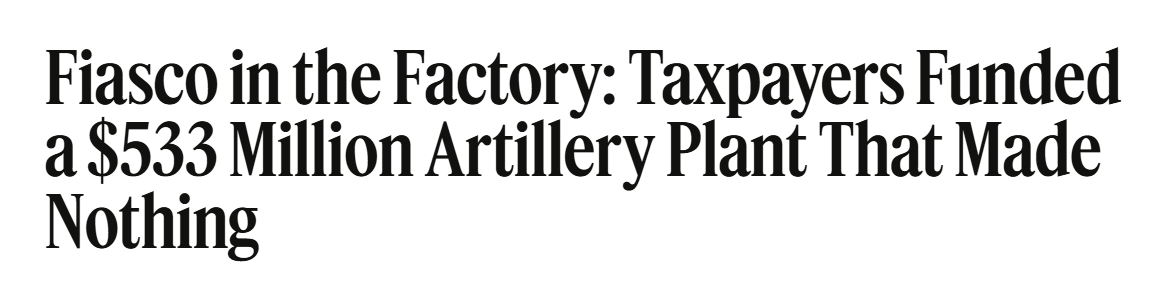
Are you surprised?
Let’s dig in to the fiasco.
First, a quick highlight of the main points:
US General Dynamics wasted half a billion dollars to produce shells for Ukraine and delivered zero
The factory located in Texas spent $533M on unproven Turkish robotic machinery in hopes to automate the process
However, robots caught fire regularly, smashed into equipment, and dropped steel parts. Giant presses required nightly sledgehammer beatings to function
The US Army halted two production lines in 2025, but never made General Dynamics pay back a dime
Since the shutdown, the General Dynamics unit responsible has received $2.5 billion in new contract awards
The ProPublica report is a hilarious venture into the absurd world of the declining US Military Industrial Complex.
It begins in striking fashion, highlighting the frequent fires that plagued the “advanced robotics” stations in the futuristic plant:
A robot was on fire. Again.
It was the summer of 2024, and the cutting-edge robots inside General Dynamics’ sweltering artillery factory near Dallas were catching fire with startling regularity, according to four former workers there. This wasn’t ideal, as the plant was supposed to be churning out urgently needed artillery shells for Ukraine. The robots, giant metal arms with clamps for hands, would end up drenched in oil, which would then — no surprise — combust as they moved steel blocks heated to 1,800 degrees into and out of a machine that periodically erupted columns of fire. One blaze that summer melted a robot’s cables, putting it out of commission for a week.
They go on to detail the spectacular and multifarious ways the machinery would regularly fail and self-destruct according to former workers of the plant, 36 of which were interviewed by ProPublica in their extensive investigation:
Instead of producing shells in an efficient and streamlined fashion, the pricey machines kept failing in bizarre ways. The robot arms would swing out of control, smashing into carefully calibrated equipment, and sometimes they would unexpectedly drop hunks of steel 5 feet down to the floor. The factory’s signature device, meant to precisely stretch the steel for the artillery shells, instead often cracked it beyond repair. Then there were the giant press machines, which required regular pounding with a sledgehammer to function properly but still botched the shaping of nearly every shell.
“We really didn’t have any standardized practice,” said Quantel White, a former employee. “It was just a bunch of guys taking turns going at the machine with a sledgehammer every night.” To workers, even the factory buildings themselves came to feel doomed, with acrid smoke hanging in 100-degree heat over foundations seemingly sinking into the earth.
The shocking conclusion: after numerous halts, the half-billion dollar factory failed to produce a single usable shell:
The situation never improved. The U.S. Army, which funded the factory, ordered work halted on two of its three production lines in August 2025. By then, General Dynamics had blown eight deadlines. Work on the third production line continued, but the facility never produced a single usable shell, according to a report from the Department of Defense’s inspector general in July.
How is it possible things have fallen this far, have deteriorated to such a level? Just how?
Recall in the 2024 piece I had ridiculed the US for importing unproven Turkish machines and workers while itself making fun of Russia for using German, Austrian, and Japanese CNC machines for its metalworking and shell production. It turns out the ridicule was well-deserved because such an overly-ambitious project was clearly too much for a sclerotically declining empire to handle.
Reading the piece, you come away with a sense that the entire ‘show’ was staged as a kind of Potemkin act meant to impress politicians desperate for a political boost. During the ‘triumphant’ opening ceremony of the facility, workers were shocked to find fake artillery shells staged to look like they were produced on the production line:
But everything was not as fantastic as it appeared. Artillery shells displayed around the plant that day had been shipped in from elsewhere, three former workers told ProPublica. A worker picked one up and was startled to discover it was fake — seemingly made of plastic. General Dynamics had already failed to perform a scheduled first article test, meant to demonstrate the facility could produce shells that met the Army’s specifications. The facility was supposed to start cranking out shells soon, but machines were barely functioning.
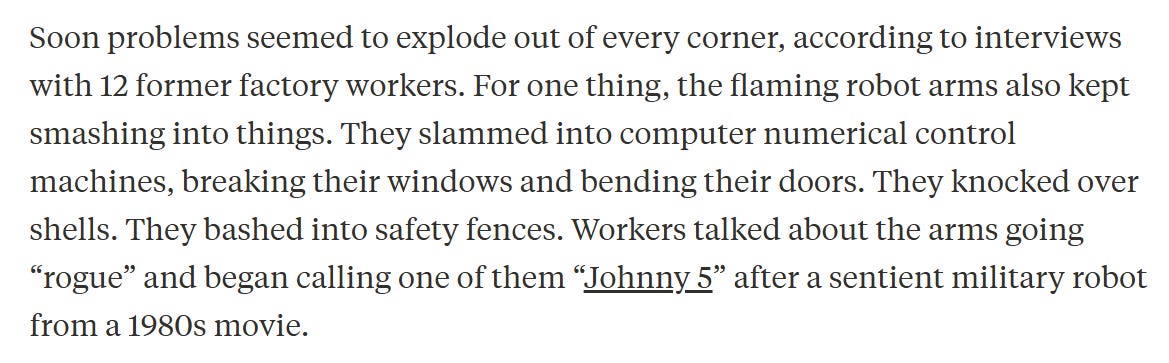
You can’t make this up—even the Turkish machines quickly deformed, and were discovered to be made with “Chinese steel”:
Soon problems seemed to explode out of every corner, according to interviews with 12 former factory workers. For one thing, the flaming robot arms also kept smashing into things. They slammed into computer numerical control machines, breaking their windows and bending their doors. They knocked over shells. They bashed into safety fences. Workers talked about the arms going “rogue” and began calling one of them “Johnny 5” after a sentient military robot from a 1980s movie.
Even simple equipment failed with slapstick regularity, six workers said. Conveyor belts broke down. Automated carts got lost. Safety gates meant to shut down machines when workers approached did not shut down machines when workers approached. A pipe exploded, spraying water up to the ceiling. Parts on Repkon machines deformed, leading a worker to discover that they were made with Chinese steel, possibly in violation of federal regulations. (The Army said it has no evidence of such violations.)
The remarkable piece really must be read in its entirety to be believed—it even includes photos of shells mangled by the erratic Turkish machines which were meant to polish them smooth, but instead turned them into Mr. Frosty swirls of mangled metal.
The piece finishes by explaining that after these failures, conventional ammo is being put on the back burner because various missiles like Patriots are now all the rage for the short-sighted MIC:
The United States still is not close to producing the promised 100,000 shells per month, a former Army official told ProPublica in June, although other investments to increase 155 mm production have turned out better. Ukraine still needs those shells, the official said, but attention has once again shifted. In the Middle East, it’s other munitions that the Trump administration has rapidly burned through during its war with Iran. Trump officials are now calling for ramping up production in those areas — and fast.
“Conventional ammo is back on the back burner,” the official said. “Everything now is about interceptors, missiles.”
Those that believe artillery still retains great importance in modern conflicts will conclude that this setback is extremely bearish for Ukraine, particularly given that Russia and North Korea are having no such issues in mass producing all necessary artillery armaments.
But even worse is the fact that European ammo factories involved in supplying the Ukrainian side have “mysteriously” been going up in flames again recently. Yesterday, the Italian firm KNDS suffered a large explosion at its plant near Rome:
BREAKING! Explosion Rocks Ammunition Factory Near Rome
A fire followed by a powerful explosion struck the Knds Ammo Italy plant (formerly Simmel Difesa) in Colleferro, outside Rome, on Thursday afternoon. The blast, felt for kilometers, hit the plant's powder-pressing department.
The facility produces medium- and large-caliber ammunition for land and naval defense, as well as solid propellants for aerospace vehicles.
Covered by Kiev Independent:
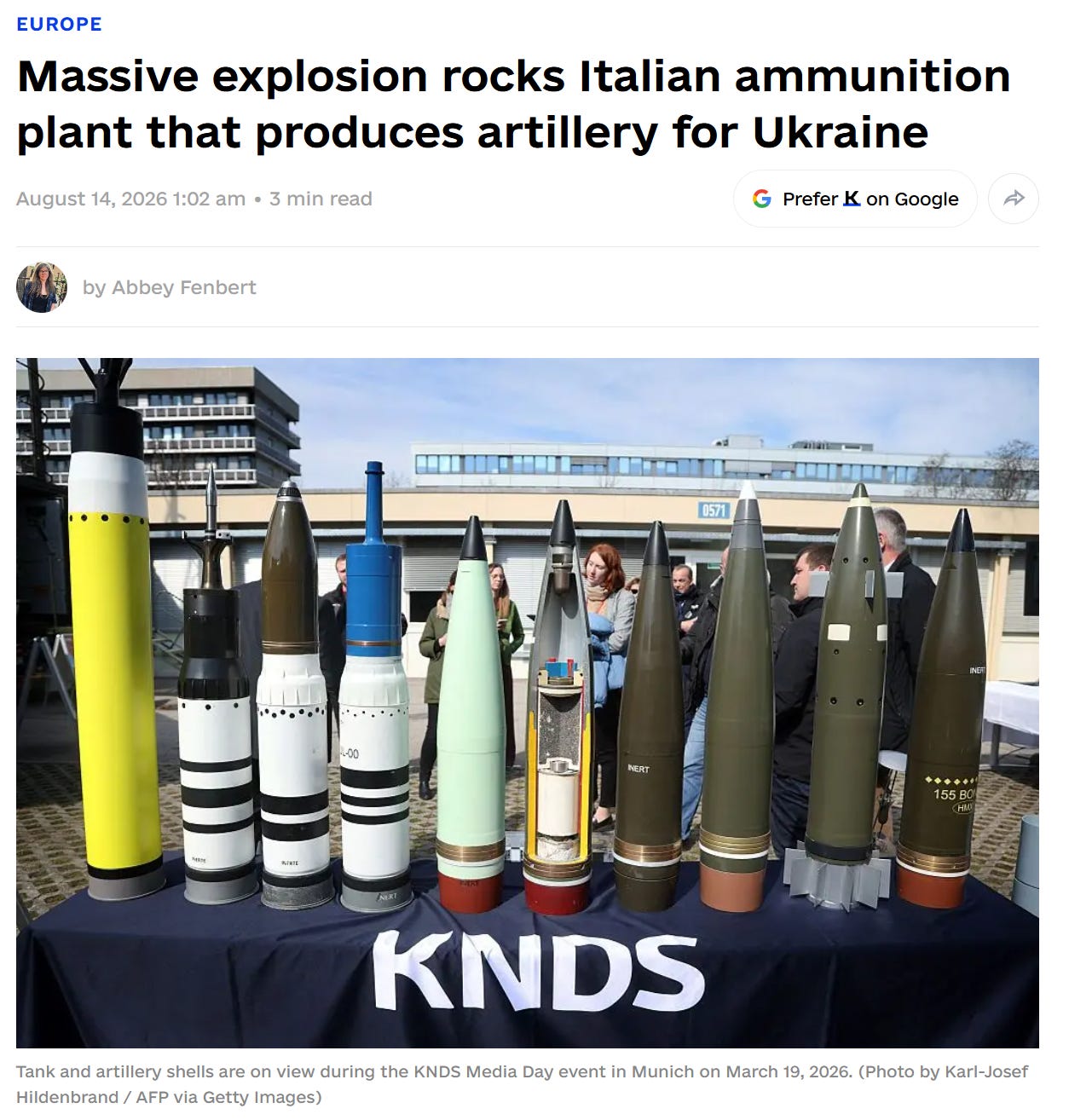
The explosion was said to have been caused by a fire in the plant’s “gunpowder processing and compression unit”.
Separately, in the same week an explosion occurred at Bulgaria’s EMCO, a company that is said to have been supplying 155mm shells to Ukraine since the start of the war:
In Bulgaria, there was an explosion in an ammunition depot.
According to local media, a truck on the depot grounds initially caught fire, after which the blaze spread a bit until it led to a detonation of ammunition.It’s probably a depot belonging to the company EMCO. The company specializes in the production and export of weapons and ammunition.
EMCO’s product range includes artillery shells in calibers 120–152 mm, armor-piercing shells, firearms, cartridges, and mines.
The outfit has been supplying weapons to Ukraine since 2014 and, after the start of the “special operation,” became one of the largest suppliers of Soviet-caliber ammunition to the Kyiv regime.
It’s clear that Russia’s reach, or that of its partisans, is not limited to Ukraine alone.
A little more clarification about what the factories produced from Russian RVoenkor channel:
Both factories that caught fire and exploded this week in Europe are linked to the supply of weapons to Ukraine.
▪️These are KNDS in Italy and EMCO in Bulgaria – both companies work with weapons and ammunition supplied to Ukraine.
▪️EMCO produces ammunition of Soviet standards: 122 and 152 mm artillery shells, rocket projectiles for the "Grad" MLRS, 60, 82, and 120 mm mortar mines, and projectiles for grenade launchers.
▪️In addition, EMCO is involved in the repair and modernization of light armored vehicles.
▪️The Italian division of KNDS produces ammunition, including NATO caliber 155 mm, for European armies and for supply to Ukraine.
▪️The holding also supplies the Ukrainian Armed Forces with CAESAR and PzH 2000 self-propelled howitzers, Leopard 1/2 tanks, Gepard anti-aircraft systems, and AMX-10 RC armored vehicles.
▪️KNDS Ukraine operates in Kyiv, providing maintenance and repair services for Western equipment, as well as localizing the production of ammunition in Ukraine.
Looks like Ukraine’s future is slowly going up in flames, or is being shoved down the tubes by subpar Turkish robots.
The question most will ask is just how significant these artillery setbacks are when most believe Ukraine functions entirely on FPV drone strikes at this point. The truth is, a war is rarely lost by one single factor alone, but rather by the culmination of various failures across the board that eventually add up to create an unsustainable environment. Russia now applies pressure on every imaginable hybrid front, creating “leaks” in the hull of the Ukrainian steamboat that are so numerous they begin to outpace the state’s ability to plug them.
It’s clear the West is no longer capable of sustaining a modern conflict in any way shape or form. Ukraine’s chief operative battlefield weapon, the FPV drone, comes primarily from China via drone parts that are assembled in Ukrainian basement shops. Should Russia continue to find ways to mitigate FPV drones, like with the recently seen Arena system, the West’s industrial failures in supplying Ukraine key weapons systems will become much more critically felt.
But beyond just Ukraine, the failure of the new General Dynamics plant highlights just how vulnerable the US itself has become in facing any future ‘Chinese threat’. With the recent announcements of US material losses in Iran, including 25% of its entire MQ-9 Reaper fleet, it’s clear that wars of the future will be decided by the industrial capability to regenerate losses indefinitely, more than anything else.
We could say it should be a wake up call then, but at this point there have been so many of these calls, it’s clear we’ve gone way beyond the point of such platitudes. We can only be reminded of the quote about the fall of Rome from the previous article. Perhaps in the future they’ll say of the US: No one noticed the collapse until one day factories were no longer capable of building even basic items.
Special thanks to you, the paid subscribers, who are reading this paywalled Premium article—you are the core contributing members keeping this blog in healthy, steadfast operation.
The Tip Jar remains as an anachronism, an archaic and shameless bit of double-dipping, for those who just can’t help lavishing their favored humble authors with a second greedy helping of largesse.